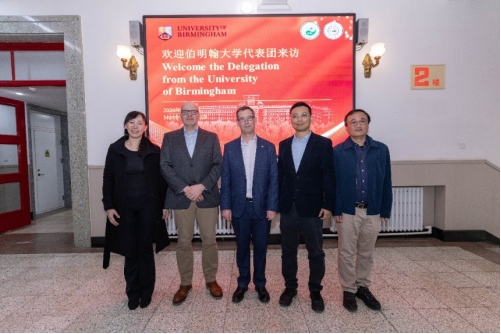
On the morning of March 25, Professor William Bloss, Vice-President of the University of Birmingham and Head of the College of Life and Environmental Sciences, together with Professor Matt Bridge, Deputy Head and Director of Education of the same college, and Associate Professor Sun Simiao, Deputy Director of International Affairs at the School of Geography, Earth and Environmental Sciences, visited our institute. Professor Dong Shuangshi, Dean of our institute, Professor Qin Chuanyu, Vice Dean, and Professor Xin Xin, Vice Dean, received Professor Bloss and his delegation and conducted in-depth exchanges.
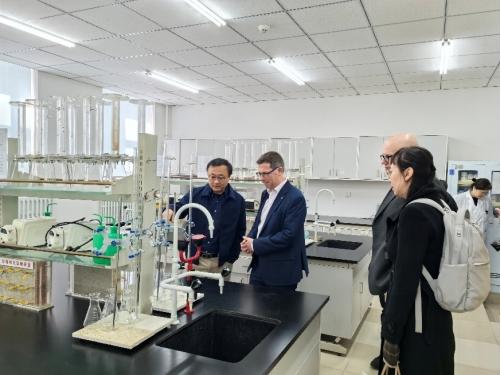
During the visit, accompanied by the leadership of our institute, the delegation first toured our undergraduate teaching laboratories. During the tour, the two sides engaged in productive exchanges on topics such as the design of experimental course systems, the arrangement of practical teaching sessions, and the cultivation of students' innovative and practical abilities. Professors Bloss and Bridge spoke highly of our institute's approach to undergraduate education, which emphasizes the integration of theory and practice and strengthens students' hands-on skills and innovative thinking. They also shared their experiences regarding the organization of relevant courses, content updates, and quality assurance.
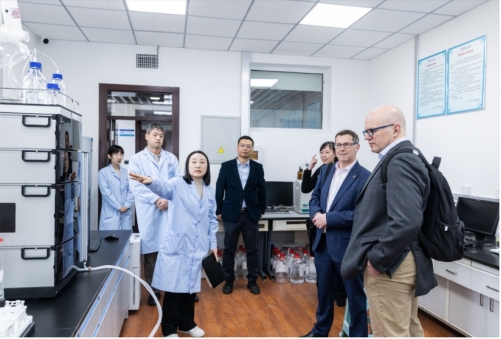
Subsequently, the delegation visited the Public Platform for Large-Scale Instrument Analysis and Testing of the Key Laboratory of Groundwater Resources and Environment, Ministry of Education. The person in charge of the platform provided a detailed introduction to its development history, the functions and application areas of the major large-scale instruments and equipment, the open-sharing operation mechanism, and the important supporting role it plays in high-level scientific research and social services. The delegation members listened attentively to the presentation and engaged in in-depth discussions with our faculty on topics including instrument performance parameters, maintenance and management, sharing efficiency, and typical cases of supporting research projects, especially international cooperation. The advanced equipment conditions, standardized management, and the platform's notable achievements in promoting disciplinary development and serving society left a deep impression on the delegation.
This on-site visit and exchange served as an important step for both sides to deepen mutual understanding and enhance trust. Through touring the laboratories and engaging in face-to-face communication, the University of Birmingham delegation gained a more intuitive and comprehensive understanding of our institute's educational philosophy, research facilities, and academic strengths. The two sides further consolidated consensus in areas such as education and teaching, talent cultivation, and scientific research collaboration within the fields of environmental and earth sciences, identifying numerous potential directions for complementary advantages and synergistic development. This has laid a more solid foundation for advancing multi-level, broad-spectrum, and substantive international cooperation between the two universities and institutes, particularly for the joint Sino-foreign cooperative education programs.